Linkbar
Ohiopyle State Park
Wednesday, March 11, 2015
0
comments
Labels:
escapes .
great allegheny passage .
ohiopyle .
pennsylvania .
photography .
pittsburgh .
summer
January and Santa Fe
Saturday, February 28, 2015
Since my return to Santa Fe nearly two months ago, the city of Boston has received more than 100 inches of snow and suffered from the harshness of brutal temperatures that seem unshakable. When I left for New Mexico, our still budding winter could be called "mild," with an enthusiasm that was premature. All the trials of a true and proper New England winter have been realized since then, and no doubt will continue to be experienced through the beginning of March. It has been beautiful at times, but in a city, winter is more annoying than anything else. It's quite a shame.
In Santa Fe, however, winter could be revered. The delicious, intoxicating smell of piñon wood wafted through the town from the start of the day to its end, just as we knew it would. It's an aroma I wish we could live with each day (or at least each winter) here in the Northeast. I can't imagine ever tiring of it. It's the type of smell which kindles a sense of fulfillment. Though we were a few weeks past Christmastime, the luminarias were still lit each evening atop the adobe buildings. It's a reason alone to visit Santa Fe in the winter months. My neighborhood in Pittsburgh had an attachment to lighting luminarias on New Year's Eve, and they've always had a spellbinding effect on me. I thought they might be gone in Santa Fe by Martin Luther King's weekend, but I was pleasantly surprised.
Crowds were few but eager, and at times we felt we had the town to ourselves. During the days, the sun shone like it was a proud duty to uphold. As soon as it set behind the mountains, the fires were lit and we exchanged our sunglasses for shivers. 50 degree temperatures during the day relinquished themselves to what felt like more New England nights, with highs only in the teens. Winter seemed civilized. We could enjoy our few, but precious days of visiting Bandelier, horseback riding, and shopping near the Plaza, without the burden of cold that is a daily reality here in Boston. Yes, it was cold at night, but only appropriately so. The mountains needed their presence to be felt in the dark, when we could no longer see their peaks. We only had the pleasure of a few days, but they were surreal ones, dominated by a landscape that inspires almost an immediate forgetfulness of our daily realities. The airplane rides back were painful ones. And then came our 100 inches of snow.
Cheers to New Mexico, then, and to spring, should it ever choose to arrive.
A Yankee Girl Visits the Southwest: Part Four
Sunday, January 11, 2015
Part Four: A Yankee Girl Visits the Southwest and Prepares to Return
In August, I ventured to New Mexico for the first time. When I left, I had every intention of planning my return. So in a few days, I will return to the land of enchantment to be charmed once again by the high desert, in the height of our Bostonian winter.
I went, only a few months ago, to whet my appetite for what John Muir called "soul hunger," and I go to do the same once more. A week was not at all enough in the varied altitudes of New Mexico, and the once capital of New Spain, the once space of the New Mexican American territory, the forever home of the Pueblo Indians.
When I left, I walked backwards on the pioneer trail, back to the sea from whence I came, to a New England world satisfied with itself, a tamed land that rebels only during winter, in protest of convenience. The skyscraper reigns in the eastern world I know, but it's the sky in the west that I want to be near again. So I'll go back, this time just to Santa Fe because that's all I have time for.
The photograph above is from Williams Lake, nestled in Taos Ski Valley. Wheeler Peak lies ahead. I would love to go back to Taos and the valley, but it will have to be another time. When I took this photograph, I had walked by foot, reaching 11,000 feet above sea level. The next day I crossed the tree line by horseback and felt as alive as I ever have. The western forests look and feel so different from the Appalachian woods I know so well, and it was invigorating to explore them in the Taos Ski Valley. Snow assuredly covers that valley now, and instead of hikers, it's filled with skiers. On the morning of my hike, I thought of D.H. Lawrence and how he wrote, "I think New Mexico was the greatest experience from the outside world that I have ever had." Most of the world had already been given over to industry and commerce and matters of reputation by Lawrence's time. Nature had already become "the other" in a way. I felt the same sort of release he undoubtedly felt as I walked the trail to Williams Lake and as I rode a very stubborn horse the following day, although he (my horse) probably wouldn't have minded an adventure in the city as a break from his own routine.
But I, I regularly feel dissatisfied with my own disconnect from the "outside world" and even calling it that seems somewhat sacrilegious. Northern New Mexico will once again temper that dissatisfaction for me and I can't wait to get back.
It's the mountains, the forests. The architecture which feels one with the earth because it is. Certainly, novelty impacted my experience. Travelers are ever besotted with the new. And perhaps there's something to be said about genes. My father has loved northern New Mexico since he was a teenager, and my mother has always appreciated it since my father introduced it to her, so long ago. That we should all find some communion with the same space is not only a comforting coincidence, but it's intriguing to me, as if it belies some greater truth about how we connect to certain places, at a very primal level.
The generations of families who have lived at Taos Pueblo would probably be able to say something about that connection. I could understand why they would never want to leave. When I was visiting the UNESCO World Heritage site, I met an artist who had come to Harvard back in the 70s and left after two years because he missed New Mexico so much. I understood him. He missed his tribe, he missed the land, he missed the mountains. And he could do without the humidity of the east and our winters, as well. Now he has a life dedicated to his craft, where there is no distinction between worlds like there was for D.H. Lawrence and for wayward travelers like myself.
So it's time to go back, and let New Mexico rejuvenate me with it's enchantment once more.
0
comments
Labels:
elsewhere .
escapes .
hiking .
history .
land of enchantment .
new mexico .
photography .
travel .
west
A Yankee Girl Visits the High Desert: Part Three
Sunday, November 9, 2014
Part Three: The Journey to Taos and
the Magic of the Mabel Dodge Luhan House
I left Santa Fe how I imagine most people do-with a desire to stay longer. But I also had plans waiting for execution and the first included taking the high road to Taos. Like most things in Northern New Mexico, "the high road to Taos" has an almost mythical quality to it, both for the religious towns that dot the way north, and also due to the shifting terrain through the Sangre de Cristo Mountains. The towns are living remnants of Spanish colonization, with names that would never be found in New England, names like Las Trampas, Ojo Sarco, Truchas, Cordova.
The one I looked forward to knowing was Chimayó.
Chimayó exists not too far from Española, where one turns sharply east to continue up the high road on route 76. Most go for religious reasons: the village is home to the El Sanctuario de Chimayó, a Catholic church and shrine that is now a National Landmark. Some people say it's one of the most important pilgrimage sites in the country. I believe it. When I went on a beautiful Friday morning, it was packed with visitors, the majority of which seemed to be present due to spiritual inclinations rather than a tourist's curiosity. The place has a long history dating to the early 19th century and is a somewhat sprawling site, filled with lots of small adobe shrines and even trading posts, like the one pictured above, selling things like holy dirt and other sacred materials. Despite this commercial aspect, it felt untouched by modernity, which is remarkable given how many people visit each year. I didn't linger long-there was another place in Chimayó I wanted to see for myself, and that was the shop of the Ortega Weavers, a family who has been weaving for centuries. Chimayó has a strong weaving tradition - the Ortega family is not alone- and I'm fascinated by how this one particular craft defined the town, not only in the 18th century, but even still today. I, of course, left with a few beautiful pieces that serve as a daily reminder of my trip, now so many months ago.
Afterwards, I continued my journey north, imagining how incredible this land must have appeared to the once Spanish settlers. Many times, I felt propelled to pull over, take pictures and record the transition from the more arid, high desert to rampant forests that seemed more appropriate to the nearby state of Colorado than New Mexico. The road was indeed winding, and one I would not like to find myself driving during a winter's night. This road is meant to be enjoyed at the height of the day, when all it's glory is bathed in sunlight.
And then I reached Taos. My first stop was to see the famous Rio Grande Gorge Bridge, a place not for those fearful of heights. It's the seventh highest bridge in the country and I've never seen anything like it before. Of course, the bridge itself was a beautiful feat of engineering, but it's the gorge below that's the main attraction. People stop, park their cars, and walk across the bridge to view it from all angles. It's hard not to be a tiny bit nervous, even if you feel exhilarated by what you see. It's a long way down.
The town itself is charming, and is home to the native Pueblo tribes, celebrities and hippies, among others, of course. I heard one person say that Taos plaza reminded her of what Santa Fe used to be, before it became such a tourist destination. But I found the same type of shops and restaurants in Taos that Santa Fe offers, which wasn't necessarily a bad thing. The experience was unique in Taos not because of the historic plaza, but because of the landscape. You can almost touch the mighty mountains with your hands.
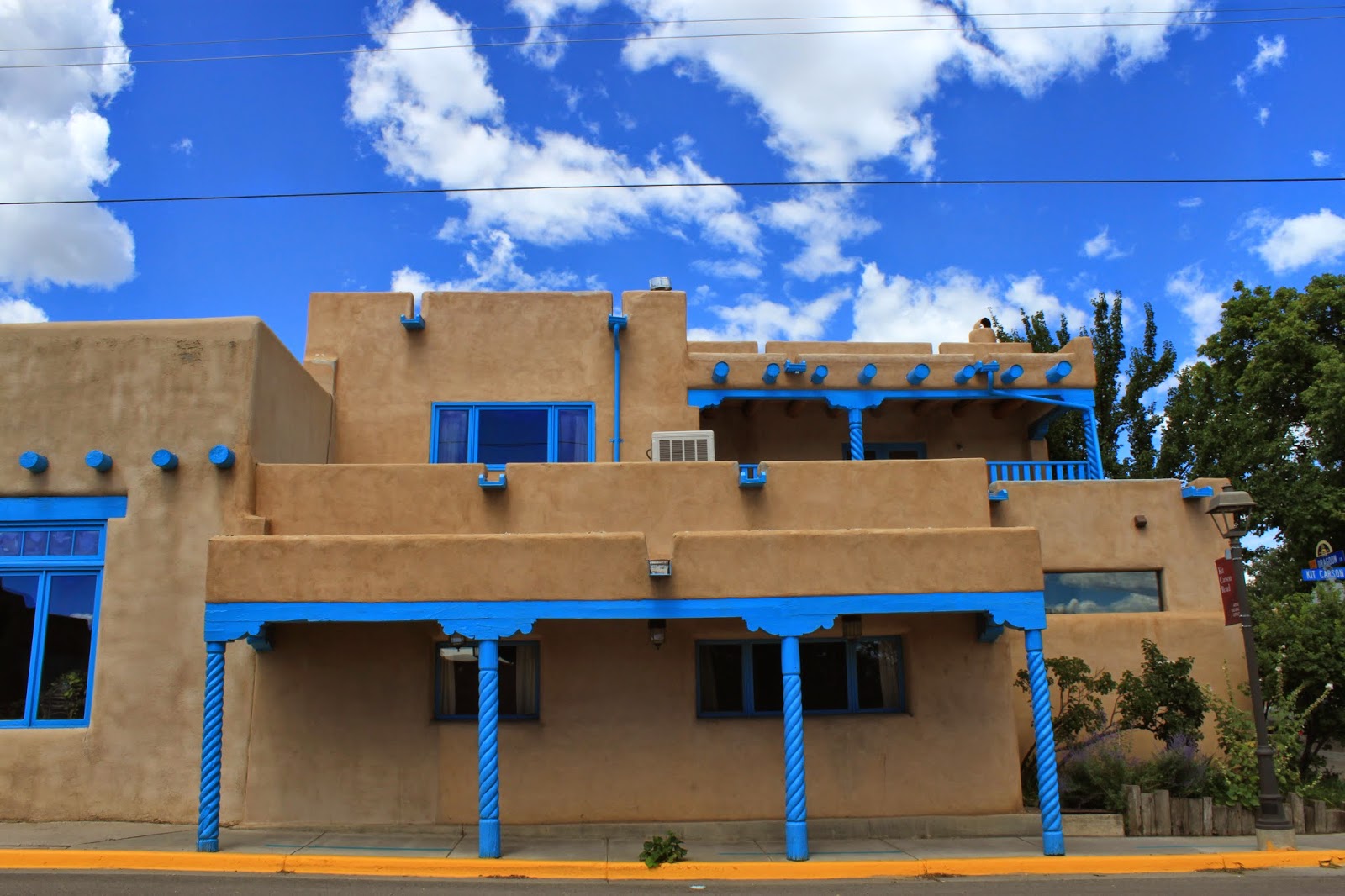
I could behold those mountains from my room at the Mabel Dodge Luhan house, the other highlight of my trip further north. I couldn't wait to arrive. I had read the memoirs of Mabel Dodge Luhan before my trip, a woman who had once entertained the likes of D.H. Lawrence and Willa Cather, among scores of others. She was quite a wealthy patron of the arts and had both the liberty and luxury to move to New Mexico as soon as she first set her eyes upon it. It was love at first sight. She had lived and moved through the artistic circles of Florence and New York, but chose the beauty that Taos had to offer and never left thereafter. Instead, she invited everyone she knew to venture west for a taste of her 'escape to reality,' as she called it. With the help of her new husband, an Indian man from the nearby Pueblo tribe, they built the house that now serves as a conference center and inn, a house I couldn't wait to see for myself.
It was truly glorious. If Mabel's intent was to create a nest of inspiration that was both stimulating to the senses and comforting, then she succeeded. Even all these years later, one can move through the rooms of the inn feeling energized by its atmosphere, created by not only the stuff of the architecture, the furniture, etc, but also by the legacy of creative souls who visited here. Two nights for me was not at all enough. I don't think a week could have been. To pass through a space that writers I've long admired and loved also knew was thrilling. In a way, it felt like home.
0
comments
Labels:
chimayo .
elsewhere .
escapes .
high road to taos .
history .
mabel dodge luhan .
new mexico .
photography .
taos
A Yankee Girl Visits the High Desert: Part Two
Monday, October 20, 2014
Part Two: Abiquiu
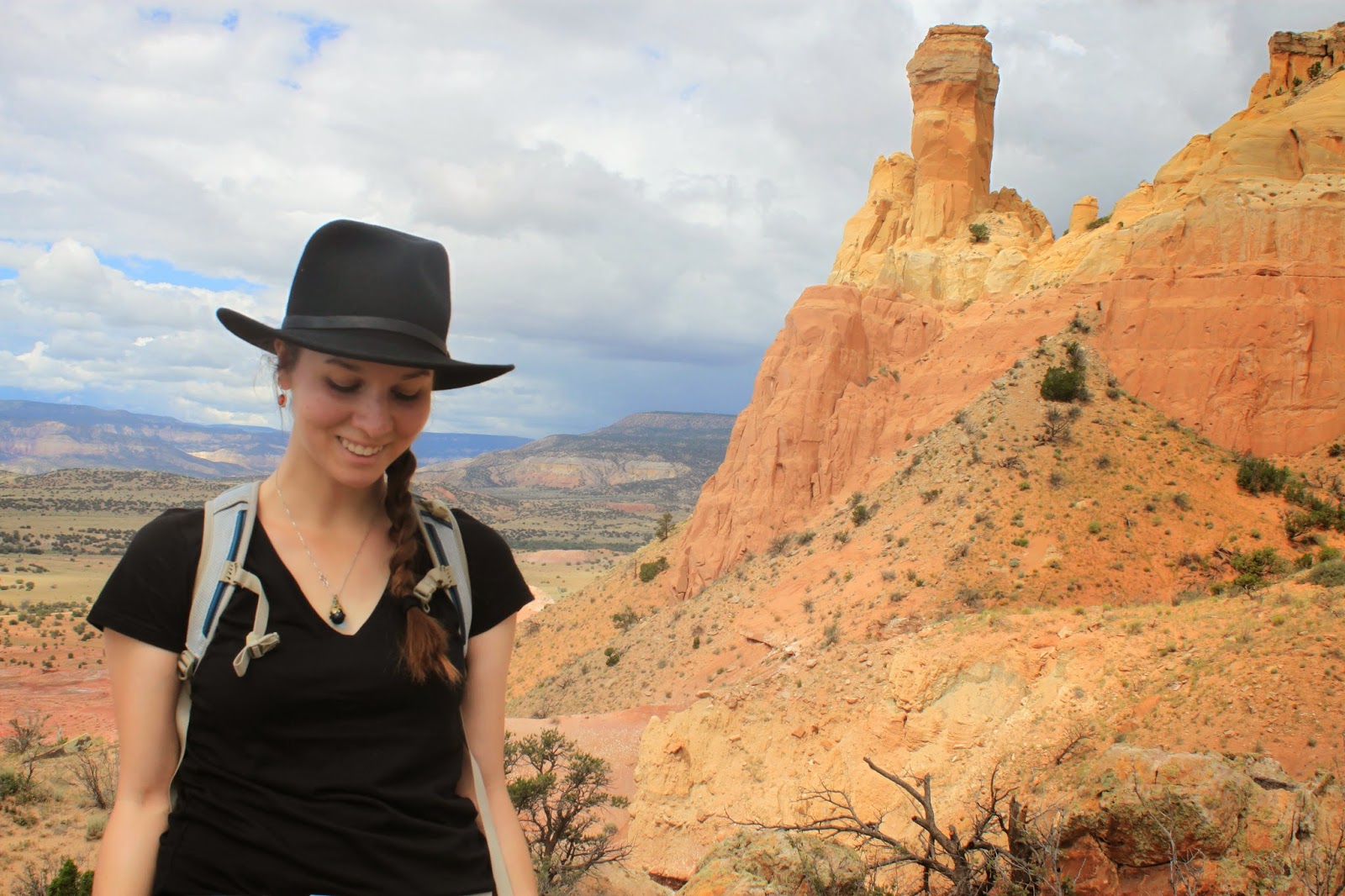
Abiquiu is a place befit for epiphanies. It exists on its own accord, defined by its hard, red earth floor and the cerulean sky that overlooks all below. It brings to mind the Jurassic Age and life of an altogether different kind, though the man-made lake at its center is evidence of our own footprint. Located about an hour northwest of Santa Fe, Abiquiu is an easy trip to make and one I personally looked forward to with great eagerness. I went for the same reason that most people go : to follow in the steps of Georgia O'Keeffe. Once she had discovered the almost mystic spell of New Mexico, she let it charm her better sense for the rest of her life. Abiquiu was her playground, the ultimate environment in which she could realize her full artistic potential. "It's the most wonderful place you can imagine. It's so beautiful there. It's ridiculous," she wrote of New Mexico in 1945. I felt her presence strongly at Ghost Ranch, what is now a retreat center but once was home to the artiste herself. Now the site is dotted with buildings that serve for various educational uses, but it's also covered with trails that one can take by foot or by horse. Alone on the trailway to Chimney Rock, I felt what Georgia must have always known in the years she lived there-a sense of complete liberation from the modern world. The mountains seemed to speak to each other, as if in constant conversation, and I was privy to their chatter. A thunderstorm threatened in the distance, but rain never fell in my path. I never felt so far from my Boston reality as I did in Abiquiu, and the distance was intoxicating, in the way that dreams can be. That red earth, so unabashedly naked, could not have been more different from the shy, dense forests of New England that I hold in deep reverence. I have no doubt that this exhilarating difference was part of what enthralled O'Keeffe. Development is scarce and frankly, it's a relief. It's a relief to know that visitors can still feel the full effect of this great land, and that locals can live their lives defined by it.
0
comments
Labels:
abiquiu .
elsewhere .
escapes .
georgia o keeffe .
land of enchantment .
new mexico .
photography .
southwest .
travel
A Lady Escapes: The Exterior of Fallingwater
Thursday, August 7, 2014
Continuing on the Pennsylvanian theme, I had the pleasure of visiting Frank Lloyd Wright's magical Fallingwater during my recent stay back home. Located in Mill Run, very close to Ohiopyle, it's about a 1.5 hour drive from Pittsburgh through the gentle, rolling hills of southwestern PA. The place is very dear to Pittsburghers, for it was designed in 1935 for the Kaufmann family, whose iconic department stores filled the city landscape from 1871 to 2006. I grew up going to Kaufmann's, as did everyone else from the burgh. The flagship store (or 'big store'as it was always known), was located downtown on the corner of Smithfield Street and Fifth Avenue. Frank Lloyd Wright had a hand in designing certain offices in the store, and then was commissioned to design a summer home for the Kaufmanns', and Fallingwater was the result. Pittsburgh was still a sooty, dark sort of place and though the family had their residence in cozy, comfortable Fox Chapel, they wanted a true escape from the steel city. They found it at Fallingwater, the house that made the cover of Time magazine in 1938 and that has been enchanting visitors since it opened as a museum in 1964. Literally built on top of a waterfall, the house is unlike any I have ever seen. It feels like an extension of nature, as if it was born from the very water it touches. That, of course, was Wright's desire: he wanted the home to be a true representation of organic architecture. The materials all come from the region- he used only steel, sandstone, reinforced concrete and glass in his construction. Long before baby boomers and millenials became obsessed with leading an "organic" lifestyle, Wright was using the term to develop an architectural philosophy that sought both inspiration from and unity with the natural world. I've heard the criticism from people I know that Fallingwater already seems dated, but I can't wholly agree with that statement, which I think may stem from its over-popularity. Perhaps because I live in a world of New England saltboxes (which I DO love), Fallingwater still feels relevant and is still a sight to behold.
The Kaufmanns' imagined a home built with a view of the waterfall, but Wright was a visionary and did the unthinkable (with a staggering price). I took the standard tour on a week day in mid-July and the place was packed with tourists. The tour was certainly extensive and led by a very informed docent, but it was crowded, and impossible to linger in the rooms or on the many decks. There are other tours available and I'll be interested in taking another when I'm back in the area, because I'll be able to appreciate it in a nuanced way during a different season. For me, the place was too extensive for a summer home. However, most of the space is taken up by balconies- everything inside is meant to lead you back from whence you came-to return you to the source of the home: the falling water below.
0
comments
Labels:
architecture .
escapes .
fallingwater .
pennsylvania .
photography .
pittsburgh .
vacation .
wright
A Lady in Boston All rights reserved © Blog Milk Powered by Blogger
.jpg)
.jpg)