A Yankee Girl Visits the Southwest: Part Four

Sunday, January 11, 2015

Part Four: A Yankee Girl Visits the Southwest and Prepares to Return 

In August, I ventured to New Mexico for the first time. When I left, I had every intention of planning my return. So in a few days, I will return to the land of enchantment to be charmed once again by the high desert, in the height of our Bostonian winter. 
I went, only a few months ago, to whet my appetite for what John Muir called "soul hunger," and I go to do the same once more. A week was not at all enough in the varied altitudes of New Mexico, and the once capital of New Spain, the once space of the New Mexican American territory, the forever home of the Pueblo Indians.
When I left, I walked backwards on the pioneer trail, back to the sea from whence I came, to a New England world satisfied with itself, a tamed land that rebels only during winter, in protest of convenience. The skyscraper reigns in the eastern world I know, but it's the sky in the west that I want to be near again. So I'll go back, this time just to Santa Fe because that's all I have time for. 
The photograph above is from Williams Lake, nestled in Taos Ski Valley. Wheeler Peak lies ahead. I would love to go back to Taos and the valley, but it will have to be another time. When I took this photograph, I had walked by foot, reaching 11,000 feet above sea level. The next day I crossed the tree line by horseback and felt as alive as I ever have. The western forests look and feel so different from the Appalachian woods I know so well, and it was invigorating to explore them in the Taos Ski Valley. Snow assuredly covers that valley now, and instead of hikers, it's filled with skiers. On the morning of my hike, I thought of D.H. Lawrence and how he wrote, "I think New Mexico was the greatest experience from the outside world that I have ever had." Most of the world had already been given over to industry and commerce and matters of reputation by Lawrence's time. Nature had already become "the other" in a way. I felt the same sort of release he undoubtedly felt as I walked the trail to Williams Lake and as I rode a very stubborn horse the following day, although he (my horse) probably wouldn't have minded an adventure in the city as a break from his own routine. 
But I, I regularly feel dissatisfied with my own disconnect from the "outside world" and even calling it that seems somewhat sacrilegious. Northern New Mexico will once again temper that dissatisfaction for me and I can't wait to get back.
It's the mountains, the forests. The architecture which feels one with the earth because it is. Certainly, novelty impacted my experience. Travelers are ever besotted with the new. And perhaps there's something to be said about genes. My father has loved northern New Mexico since he was a teenager, and my mother has always appreciated it since my father introduced it to her, so long ago.  That we should all find some communion with the same space is not only a comforting coincidence, but it's intriguing to me, as if it belies some greater truth about how we connect to certain places, at a very primal level.


 The generations of families who have lived at Taos Pueblo would probably be able to say something about that connection. I could understand why they would never want to leave. When I was visiting the UNESCO World Heritage site, I met an artist who had come to Harvard back in the 70s and left after two years because he missed New Mexico so much. I understood him. He missed his tribe, he missed the land, he missed the mountains. And he could do without the humidity of the east and our winters, as well. Now he has a life dedicated to his craft, where there is no distinction between worlds like there was for D.H. Lawrence and for wayward travelers like myself. 
So it's time to go back, and let New Mexico rejuvenate me with it's enchantment once more. 


A Yankee Girl Visits the High Desert: Part Three

Sunday, November 9, 2014


Part Three: The Journey to Taos and
the Magic of the Mabel Dodge Luhan House 

I left Santa Fe how I imagine most people do-with a desire to stay longer. But I also had plans waiting for execution and the first included taking the high road to Taos.  Like most things in Northern New Mexico, "the high road to Taos" has an almost mythical quality to it, both for the religious towns that dot the way north, and also due to the shifting terrain through the Sangre de Cristo Mountains. The towns are living remnants of Spanish colonization, with names that would never be found in New England, names like Las Trampas, Ojo Sarco, Truchas, Cordova
The one I looked forward to knowing was Chimayó

Chimayó exists not too far from Española, where one turns sharply east to continue up the high road on route 76. Most go for religious reasons: the village is home to the El Sanctuario de Chimayó, a Catholic church and shrine that is now a National Landmark. Some people say it's one of the most important pilgrimage sites in the country. I believe it. When I went on a beautiful Friday morning, it was packed with visitors, the majority of which seemed to be present due to spiritual inclinations rather than a tourist's curiosity. The place has a long history dating to the early 19th century and is a somewhat sprawling site, filled with lots of small adobe shrines and even trading posts, like the one pictured above, selling things like holy dirt and other sacred materials. Despite this commercial aspect, it felt untouched by modernity, which is remarkable given how many people visit each year. I didn't linger long-there was another place in Chimayó I wanted to see for myself, and that was the shop of the Ortega Weavers, a family who has been weaving for centuries. Chimayó has a strong weaving tradition - the Ortega family is not alone- and I'm fascinated by how this one particular craft defined the town, not only in the 18th century, but even still today. I, of course, left with a few beautiful pieces that serve as a daily reminder of my trip, now so many months ago. 

Afterwards, I continued my journey north, imagining how incredible this land must have appeared to the once Spanish settlers. Many times, I felt propelled to pull over, take pictures and record the transition from the more arid, high desert to rampant forests that seemed more appropriate to the nearby state of Colorado than New Mexico. The road was indeed winding, and one I would not like to find myself driving during a winter's night. This road is meant to be enjoyed at the height of the day, when all it's glory is bathed in sunlight.


And then I reached Taos. My first stop was to see the famous Rio Grande Gorge Bridge, a place not for those fearful of heights. It's the seventh highest bridge in the country and I've never seen anything like it before. Of course, the bridge itself was a beautiful feat of engineering, but it's the gorge below that's the main attraction. People stop, park their cars, and walk across the bridge to view it from all angles. It's hard not to be a tiny bit nervous, even if you feel exhilarated by what you see. It's a long way down. 

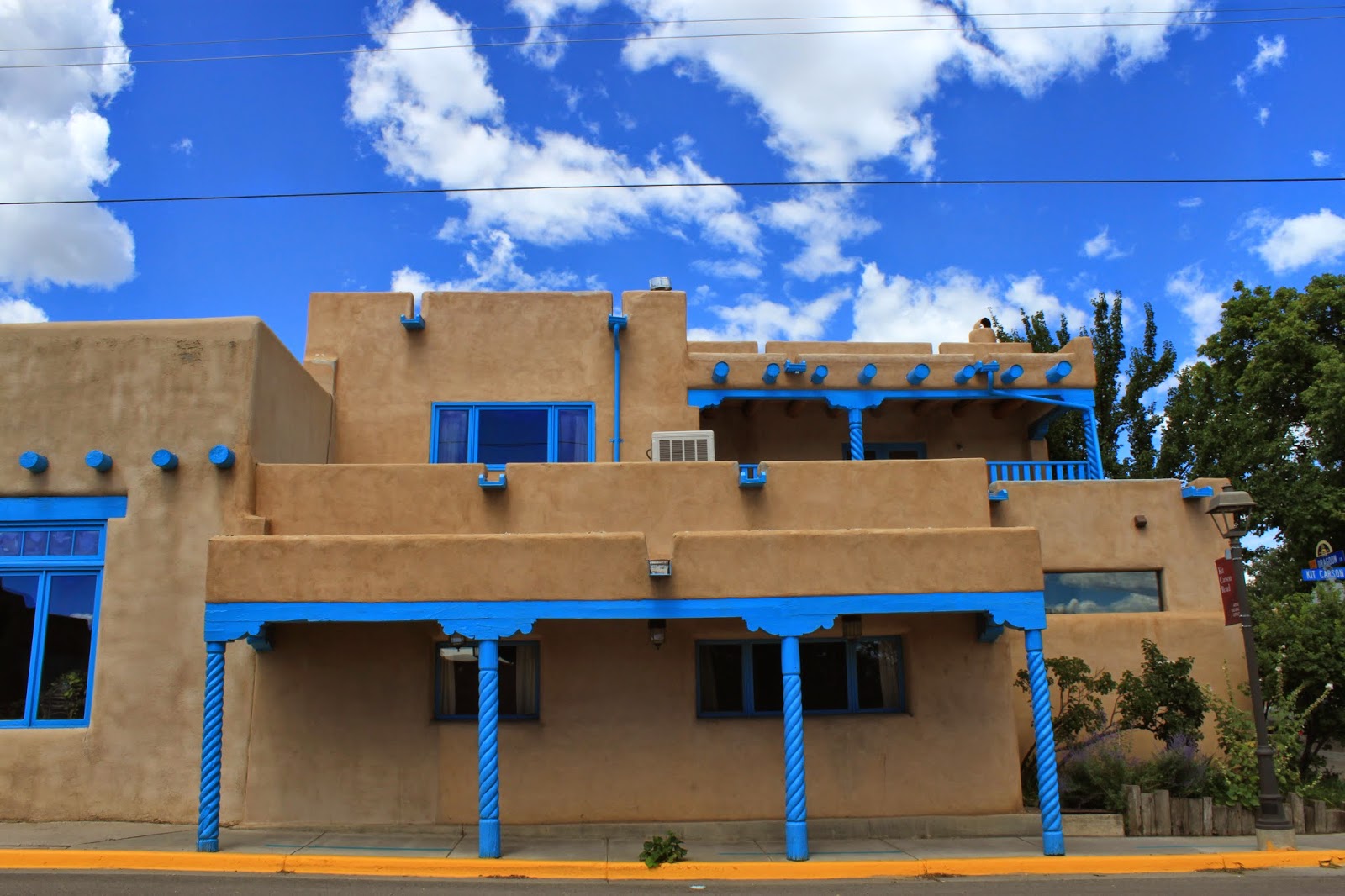
The town itself is charming, and is home to the native Pueblo tribes, celebrities and hippies, among others, of course. I heard one person say that Taos plaza reminded her of what Santa Fe used to be, before it became such a tourist destination. But I found the same type of shops and restaurants in Taos that Santa Fe offers, which wasn't necessarily a bad thing. The experience was unique in Taos not because of the historic plaza, but because of the landscape. You can almost touch the mighty mountains with your hands. 

I could behold those mountains from my room at the Mabel Dodge Luhan house, the other highlight of my trip further north. I couldn't wait to arrive. I had read the memoirs of Mabel Dodge Luhan before my trip, a woman who had once entertained the likes of D.H. Lawrence and Willa Cather, among scores of others. She was quite a wealthy patron of the arts and had both the liberty and luxury to move to New Mexico as soon as she first set her eyes upon it. It was love at first sight. She had lived and moved through the artistic circles of Florence and New York, but chose the beauty that Taos had to offer and never left thereafter. Instead, she invited everyone she knew to venture west for a taste of her 'escape to reality,' as she called it. With the help of her new husband, an Indian man from the nearby Pueblo tribe, they built the house that now serves as a conference center and inn, a house I couldn't wait to see for myself. 

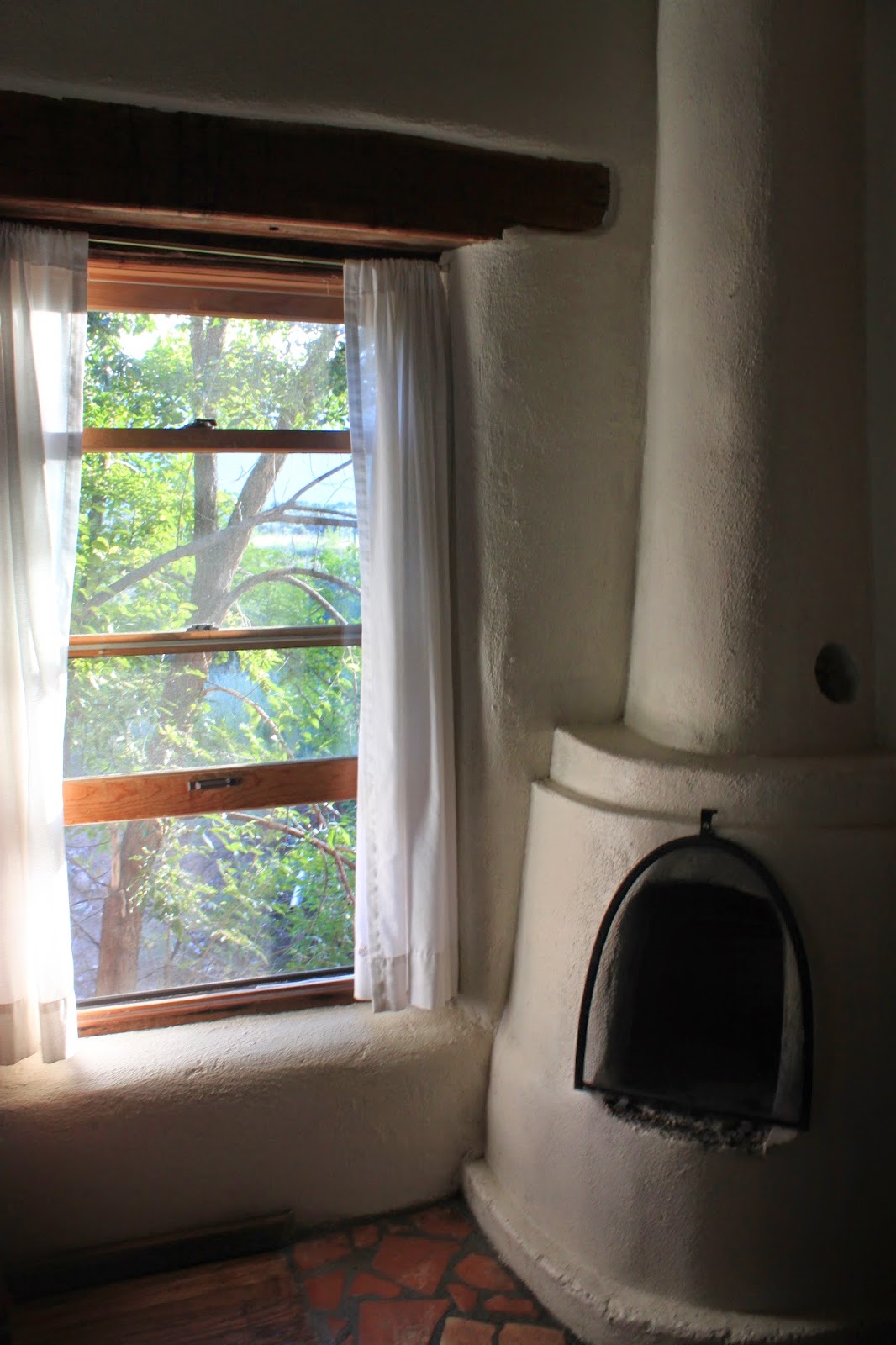
It was truly glorious. If Mabel's intent was to create a nest of inspiration that was both stimulating to the senses and comforting, then she succeeded. Even all these years later, one can move through the rooms of the inn feeling energized by its atmosphere, created by not only the stuff of the architecture, the furniture, etc, but also by the legacy of creative souls who visited here. Two nights for me was not at all enough. I don't think a week could have been. To pass through a space that writers I've long admired and loved also knew was thrilling. In a way, it felt like home. 

A Yankee Girl Visits the High Desert: Part One

Sunday, October 12, 2014

Part One: Land of Enchantment

In the middle of August, I took myself west. My mind left many months earlier, however, and part of it is still there now, roaming the high desert.  Up until recently, the all great American West existed in my mind as a myth, a vast area less of a geographical reality and more as romanticized vision, which largely kept to images of covered wagons and the pioneers who walked the way beside them, with all the tales of their trials and tribulations. I keep to those stories because in truth, I love them. The stories of how the west became American are not fairy tales in the least, but I've had a love affair with them my entire life. And still, my travels have always taken me eastward-to Europe or beyond. My American life has been spent overseas or strictly in the Northeast, leaving anywhere west of the Mississippi to the domains of my imagination and historical understanding. 
But on my vacation, I only went to one place. And when I write, "one place," I mean one particular region of one state, so the 'west' of my August in the year 2014 was northern New Mexico, land of enchantment. I chose it as my destination not because I was drawn by the history of the state, but rather because I was intrigued by the history of my parents, who went in the years they were married. In fact, I knew very little about the particulars of New Mexican history, let alone geography-which brought to the surface so keenly the Northeast's preoccupation with self, not to mention New England exceptionalism. One thinks of the desert as they envision New Mexico, and he or she would be right to do so, but they do not know of the altitude. With delight I marveled at the peaks of Albuquerque, Santa Fe and Taos. The fact that Santa Fe is the highest state capital in the country seemed to shock everyone I mentioned it to. More often than not, people were bewildered at my choice of destination. 
Once I firmly decided to go, I wasted no time in conquering my long-serving ignorance of the area, which had only made an exception during the times I read of Georgia O'Keeffe's life there. I started with travel guides, which gave me brief overviews of history, politics and sightseeing. I scoured the web for anything to watch, including Smithsonian's 'Aerial America' episode on New Mexico; C-span's collection of short videos on Santa Fe landmarks; and multiple re-viewings of Ken Burns'  documentary"The West." One day during my lunch break, I stumbled upon the wonderfully penned,  Land of Enchantment: Memoirs of Marian Russell Along the Santa Fe Trail in the always reliable Brattle Book Shop. Somehow I had managed to remain unaware of this book until that moment, despite a class I once took in college called "Women's Literature on the Frontier." Marian Russell's recollections placed me right on the Santa Fe Trail in the second half of the 19th century, with all its violence and significance. From there, I was reading Mabel Dodge Luhan's memoirs of a half-century later, when she invited the creative luminaries of the age to her house in Taos, including the likes of D.H. Lawrence, Ansel Adams, Willa Cather, and scores of others. I read the essays collected in Tony Hillerman's "The Spell of New Mexico" and naturally Cather's "Death Comes to the Archbishop." I daydreamed of my future travels. A lot. I planned what I would bring with me a month before, including newly purchased items like a wide-brimmed black hat -perfect for the cowgirl I am definitely not- a Midori Traveler's Notebook, and the hiking boots I would wear in Taos Ski Valley. I savored with each and every day the steady sweetness of anticipation. My New England adventures dropped to a minimum. I was too pleasantly distracted by the planning and intellectual preparation  for my journey to fully appreciate summer's arrival in Massachusetts. And suddenly, it was time to go and actually experience all I had thought about for months on end. At least part of me wanted another week to prepare. Though I embrace spontaneity in my local travels, I strongly believe in the necessity of place preparation, but then I am a lover of history, art and literature, which collectively form so many of the reasons an area is unique unto itself. 
Let me be the first to tell you if you don't already know : New Mexico is truly unique.

*** 

One may question the practicality of a summer vacation in New Mexico, but I found the dry, mountain air just as refreshing as the New England sea breeze that I left behind. The altitude, however, was a force to be reckoned with and one that left me feeling seemingly tipsy in the middle of the night. The heat of the sun bothered me only once: on my arrival day hike at the glorious Kasha-Katuwe Tent Rocks Monument.  Despite the blaze of the sun, it could hardly succeed in distracting me from the majestic rock formations, the result of volcanic eruptions several million years ago. The place felt quite isolated, and because of that, all the more wild. A few other hikers were nearby, but on the whole, the site was quiet, as if to say, left to itself. At one point, a rattlesnake made his presence known on the trail, inviting us humans to watch as he feasted on his chosen prey. That seemed a natural turning point, and my travel fatigue made the better of me. I left and took off for Santa Fe.   

My temporary place of home was at the utterly charming Madeleine Inn, a rare piece of Victorian architecture in the land of the adobe structure, and  one covered with ivy like the Boston buildings I pass every day. I couldn't have chosen a better place to stay and for this particular traveler, that meant a kind staff, comfortable room and very good breakfasts. From the inn's location on E. Faithway Street, I could walk anywhere I liked in the city of Santa Fe. And so I did. 

In many ways, I was predisposed to liking Santa Fe-first by my genes and then by months of research. However, I'm certain that even without those two predetermining factors, I would have fallen for the place. It has aged remarkably well and is so comfortable with itself, like the towns and cities of Europe whose identities have long been established. We, Yankees of the North, revel in the history of our forefathers and take pride in the footprints they've left behind, all with a sort of smug satisfaction in the belief that our streets and houses are the oldest of this country. How refreshing it was to find the stamp of the Spanish on Santa Fe and the residue of the 1500s! Before it was hailed New Mexico, it was the northern capital of New Spain. And before that, it was land used by the Pueblo Indians. After the Indian revolt of 1680, Pueblo Indians held Santa Fe once more, but only until 1692, when the city was re-captured by the Spanish. So the city was Spanish, until it became Mexican, and then it became American, but not a state until 1912, which seems shockingly late given that it was a territory in 1848. Thus, New Mexico is a place where multiple traditions mingle and yet still flourish, despite the passing of time. Santa Fe is its best example. The result of this mixed history is a city so beguiling it's hard to believe it's real. There's shadow play on the Plaza and courtyards with hanging chilies; churches with spiral staircases and rows of doors painted blue. There are more museums than one has time to see and literally hundreds of art galleries, most of which live side by side on the famous Canyon Road.  People watch opera as thunderstorms roll through the valley and in the winter time, luminaries cover the streets. 

And though it is a cliche, I now know where enchantment is found: in the high, American desert. 

Nearby: Oldies Marketplace in Newburyport

Tuesday, July 15, 2014


When my mother came to visit a few weeks ago, I chose to take her to the little town on the North Shore that has recently taken my fancy: Newburyport. I took her so she  could see the lovingly restored homes of 17th and 18th centuries and the quiet beauty of its town center, composed of wonderful shops that few Bostonians strangely never seem to mention.  

One such shop, which proudly announces itself with its wild storefront and creative facade, is located on the rear of Water Street and goes by the name of "Oldies Marketplace." 
And what a place it is!
 We did not prepare to spend the better part of an hour there, but would have had it no other way-for there was too much to see and consider - too many objects to momentarily hold in our hands while questioning their possible place in our decorative lives. 
I left with a pewter creamery; my mother with a nautical print to give as a gift. 
The best thing about Oldies Marketplace is its size and its inviting layout. Naturally, one can easily find the good and the bad in places like these. But unlike other similar stores, Oldies effortlessly creates the desire in the visitor to stay and search. One is neither overwhelmed by the array of items available nor the dust that they may carry-one is only enthralled. 
And pretty soon, you have spent an hour collecting treasures you never expected to find in the old shipping center of Newburyport. 


Nearby: Georges Island

Sunday, June 29, 2014


I had high hopes of a June filled with entries of my small explorations.  Alas! 
July arrives on Tuesday and I'm waving goodbye to June of 2014 without the pleasure of truly knowing it. But there were at least a few adventures I was lucky enough to experience, some of which I shall try to write of in the coming weeks and the rest that I'll remember only in my mind. 

I met Georges Island on the first weekend of the month. One of the harbor boats led me there from the wharf and in an hour I found myself seeing Fort Warren for the first time. 
Named for the Boston revolutionary Dr. Joseph Warren, it was built in the mid-19th century and is known today for it's significance during the Civil War. This is where imprisoned Confederate soldiers and political prisoners, such as Confederate Vice President Alexander Hamilton Stephens learned of the cruel New England winter for the first time. They could direct their gazes towards the untouched city of Boston and they could long for their own homes. But this fort became their Northern home in a way, and I could wander silently through it, with only the sound of nearby families exploring at their own pace (faster or slower depending on the courage of the children). The walls are splattered with the memories of the past 150 years, memories of those who dwelt within its rooms along with the ones who have since visited them. A dark quiet lingers throughout the insides of the fort where shadows seem to reign.

But then there are the ramparts and the green pathways that cover the dark rooms and they are all beauty, as if they are rooftop gardens dating from the Civil War. 
Prisoners could take their walks and look out to the sea, to either think of places like Shiloh and Antietam and Fredericksburg or choose to forget about them entirely. As I walked, I thought of ghosts, like the Lady in Black, who is said to still haunt the Fort. 
Yet, it was a perfect June day, dominated by sunshine and blue skies, and I could only feel invigorated to be there and happy the fort still stands, to impart knowledge to anyone who is curious enough to accept it. 

A Lady in Boston All rights reserved © Blog Milk Powered by Blogger