January and Santa Fe

Saturday, February 28, 2015


Since my return to Santa Fe nearly two months ago, the city of Boston has received more than 100 inches of snow and suffered from the harshness of brutal temperatures that seem unshakable. When I left for New Mexico, our still budding winter could be called "mild," with an enthusiasm that was premature. All the trials of a true and proper New England winter have been realized since then, and no doubt will continue to be experienced through the beginning of March. It has been beautiful at times, but in a city, winter is more annoying than anything else. It's quite a shame. 
In Santa Fe,  however, winter could be revered. The delicious, intoxicating smell of piƱon wood wafted through the town from the start of the day to its end, just as we knew it would. It's an aroma I wish we could live with each day (or at least each winter) here in the Northeast. I can't imagine ever tiring of it. It's the type of smell which kindles a sense of fulfillment. Though we were a few weeks past Christmastime, the luminarias were still lit each evening atop the adobe buildings. It's a reason alone to visit Santa Fe in the winter months. My neighborhood in Pittsburgh had an attachment to lighting luminarias on New Year's Eve, and they've always had a spellbinding effect on me. I thought they might be gone  in Santa Fe by Martin Luther King's weekend, but I was pleasantly surprised. 
 Crowds were few but eager, and at times we felt we had the town to ourselves.  During the days, the sun shone like it was a proud duty to uphold. As soon as it set behind the mountains, the fires were lit and we exchanged our sunglasses for shivers. 50 degree temperatures during the day relinquished themselves to what felt like more New England nights, with highs only in the teens. Winter seemed civilized. We could enjoy our few, but precious days of visiting Bandelier, horseback riding, and shopping near the Plaza, without the burden of cold that is a daily reality here in Boston.  Yes, it was cold at night, but only appropriately so. The mountains needed their presence to be felt in the dark, when we could no longer see their peaks. We only had the pleasure of a few days, but they were surreal ones, dominated by a landscape that inspires almost an immediate forgetfulness of our daily realities. The airplane rides back were painful ones. And then came our 100 inches of snow. 
Cheers to New Mexico, then, and to spring, should it ever choose to arrive. 

A Yankee Girl Visits the Southwest: Part Four

Sunday, January 11, 2015

Part Four: A Yankee Girl Visits the Southwest and Prepares to Return 

In August, I ventured to New Mexico for the first time. When I left, I had every intention of planning my return. So in a few days, I will return to the land of enchantment to be charmed once again by the high desert, in the height of our Bostonian winter. 
I went, only a few months ago, to whet my appetite for what John Muir called "soul hunger," and I go to do the same once more. A week was not at all enough in the varied altitudes of New Mexico, and the once capital of New Spain, the once space of the New Mexican American territory, the forever home of the Pueblo Indians.
When I left, I walked backwards on the pioneer trail, back to the sea from whence I came, to a New England world satisfied with itself, a tamed land that rebels only during winter, in protest of convenience. The skyscraper reigns in the eastern world I know, but it's the sky in the west that I want to be near again. So I'll go back, this time just to Santa Fe because that's all I have time for. 
The photograph above is from Williams Lake, nestled in Taos Ski Valley. Wheeler Peak lies ahead. I would love to go back to Taos and the valley, but it will have to be another time. When I took this photograph, I had walked by foot, reaching 11,000 feet above sea level. The next day I crossed the tree line by horseback and felt as alive as I ever have. The western forests look and feel so different from the Appalachian woods I know so well, and it was invigorating to explore them in the Taos Ski Valley. Snow assuredly covers that valley now, and instead of hikers, it's filled with skiers. On the morning of my hike, I thought of D.H. Lawrence and how he wrote, "I think New Mexico was the greatest experience from the outside world that I have ever had." Most of the world had already been given over to industry and commerce and matters of reputation by Lawrence's time. Nature had already become "the other" in a way. I felt the same sort of release he undoubtedly felt as I walked the trail to Williams Lake and as I rode a very stubborn horse the following day, although he (my horse) probably wouldn't have minded an adventure in the city as a break from his own routine. 
But I, I regularly feel dissatisfied with my own disconnect from the "outside world" and even calling it that seems somewhat sacrilegious. Northern New Mexico will once again temper that dissatisfaction for me and I can't wait to get back.
It's the mountains, the forests. The architecture which feels one with the earth because it is. Certainly, novelty impacted my experience. Travelers are ever besotted with the new. And perhaps there's something to be said about genes. My father has loved northern New Mexico since he was a teenager, and my mother has always appreciated it since my father introduced it to her, so long ago.  That we should all find some communion with the same space is not only a comforting coincidence, but it's intriguing to me, as if it belies some greater truth about how we connect to certain places, at a very primal level.


 The generations of families who have lived at Taos Pueblo would probably be able to say something about that connection. I could understand why they would never want to leave. When I was visiting the UNESCO World Heritage site, I met an artist who had come to Harvard back in the 70s and left after two years because he missed New Mexico so much. I understood him. He missed his tribe, he missed the land, he missed the mountains. And he could do without the humidity of the east and our winters, as well. Now he has a life dedicated to his craft, where there is no distinction between worlds like there was for D.H. Lawrence and for wayward travelers like myself. 
So it's time to go back, and let New Mexico rejuvenate me with it's enchantment once more. 


A Yankee Girl Visits the High Desert: Part Two

Monday, October 20, 2014

Part Two: Abiquiu


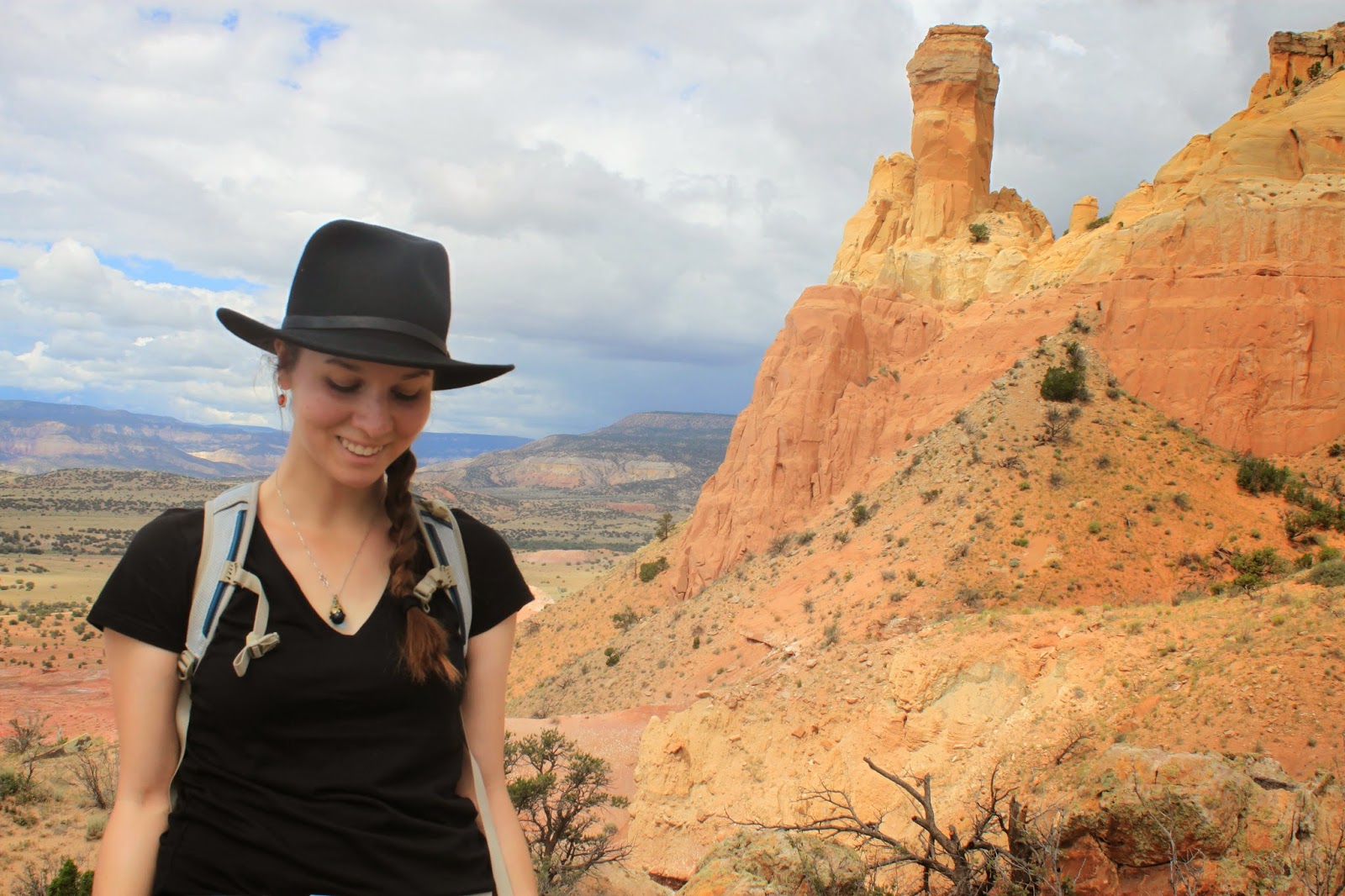
Abiquiu is a place befit for epiphanies. It exists on its own accord, defined by its hard, red earth floor and the cerulean sky that overlooks all below. It brings to mind the Jurassic Age and life of an altogether different kind, though the man-made lake at its center is evidence of our own footprint. Located about an hour northwest of Santa Fe, Abiquiu is an easy trip to make and one I personally looked forward to with great eagerness. I went for the same reason that most people go : to follow in the steps of Georgia O'Keeffe. Once she had discovered the almost mystic spell of New Mexico, she let it charm her better sense for the rest of her life.  Abiquiu was her playground, the ultimate environment in which she could realize her full artistic potential. "It's the most wonderful place you can imagine. It's so beautiful there. It's ridiculous," she wrote of New Mexico in 1945. I felt her presence strongly at Ghost Ranch, what is now a retreat center but once was home to the artiste herself. Now the site is dotted with buildings that serve for various educational uses, but it's also covered with trails that one can take by foot or by horse. Alone on the trailway to Chimney Rock, I felt what Georgia must have always known in the years she lived there-a sense of complete liberation from the modern world. The mountains seemed to speak to each other, as if in constant conversation, and I was privy to their chatter. A thunderstorm threatened in the distance, but rain never fell in my path. I never felt so far from my Boston reality as I did in Abiquiu, and the distance was intoxicating, in the way that dreams can be. That red earth, so unabashedly naked, could not have been more different from the shy, dense forests of New England that I hold in deep reverence. I have no doubt that this exhilarating difference was part of what enthralled O'Keeffe. Development is scarce and frankly, it's a relief. It's a relief to know that visitors can still feel the full effect of this great land, and that locals can live their lives defined by it. 


A Lady in Boston All rights reserved © Blog Milk Powered by Blogger