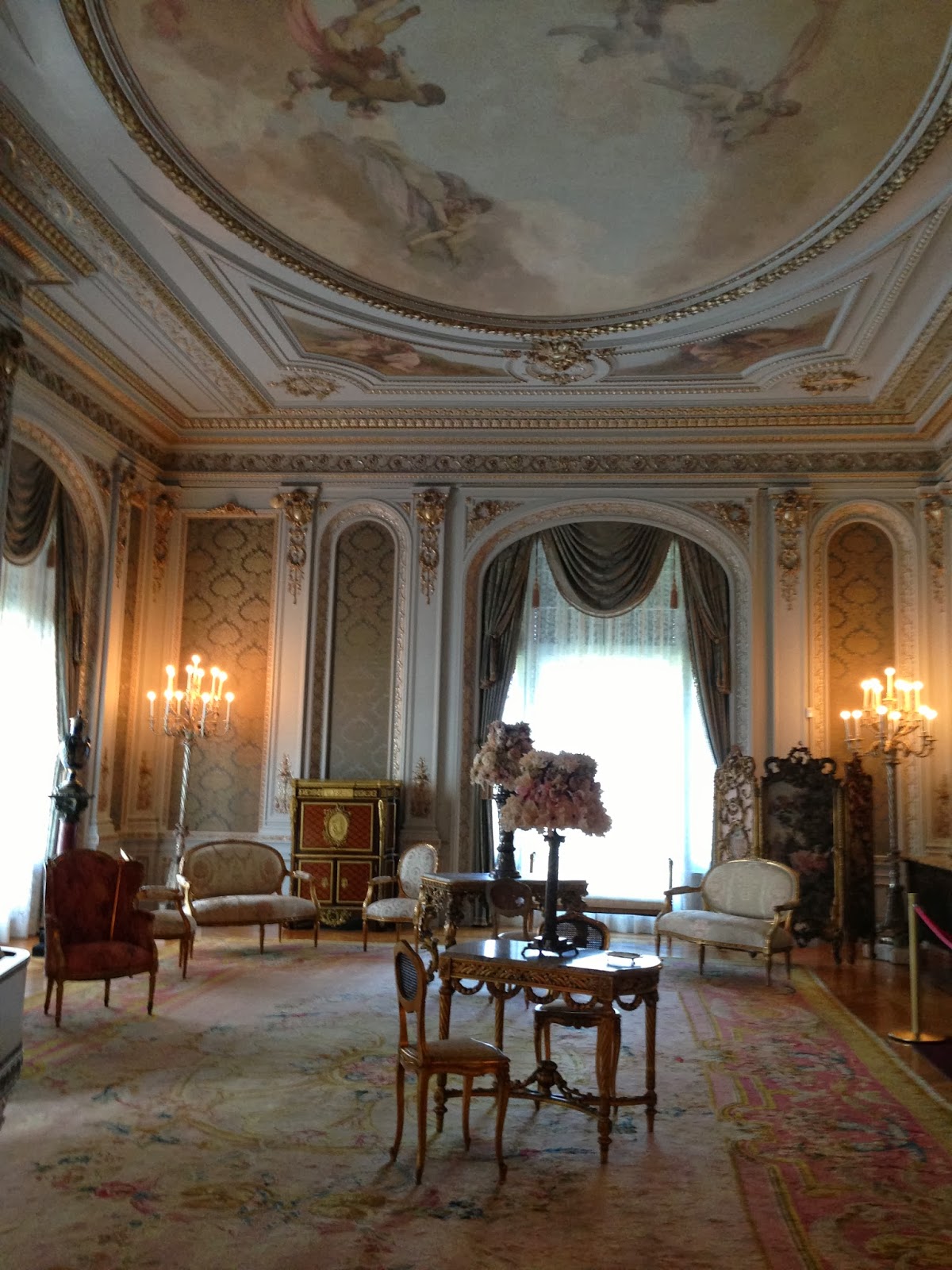
Two months ago I took a bit of a joy trip to southern Florida, where my family very conveniently has a vacation home. Though I have been visiting Palm Beach County since before I could walk, I somehow never made it to the Flagler Museum. Once home to industrialist Henry Flagler, "Whitehall" was built as a grand estate for a true, Gilded Age tycoon. Constructed in 1902 as a wedding present for his wife, Whitehall ranks as of the greatest representations of American wealth and luxury and is now today a National Landmark. Boasting as many as seventy-five rooms, it took a friend and me two and a half hours to see it all. Unfortunately, Henry Flagler's legacy has been somewhat lost amidst the histories of other great industrialists, of men like Carnegie and Vanderbilt and Rockefeller. However, the Flagler Museum gave me two opportunities: one to address my own ignorance regarding his influence and one to admire the absolutely beautiful (and sometimes strange) interiors in which he resided.
Linkbar
MFA Interiors
Wednesday, February 13, 2013
A couple of more pictures from my recent trip to MFA. I've been a tad under the weather and what with the blizzard, I haven't been able to do as much exploring as I'd like. Hopefully this weekend will be a bit more promising. One can hope!
Just for fun, below are pictures I took with my iphone a couple years ago when I visited MFA with my mother. Enjoy!
The African Meeting House
Monday, January 21, 2013
Tucked away in a corner of Beacon Hill lies the African Meeting House, along with the Museum of African American History. In honor of Martin Luther King, Jr. Day, I ventured out to visit both. In truth, the museum was much smaller than I imagined it to be, but I was struck by the loveliness of the meeting house, which was originally built in 1806. A recent, $9.5-million-dollar project has restored the meeting house to its 1855 appearance and I found it both warm and inviting.
The meeting house was actually home to a number of different activities. First, it served as a church (to which it bears the title of the oldest black church edifice still standing in the country today). Secondly, the space was used for private educational classes. But most importantly, it was the site of anti-slavery meetings and discussions. It was here that the most famous of abolitionists conducted much of their business, abolitionists like William Lloyd Garrison and Frederick Douglass. Before today, I had no idea that the north slope area of Beacon Hill, where the meeting house is located, was home to the all-free black community of Boston.
The African Meeting House is just one stop of many along the Black Heritage Trail.
Other landmarks include:
-Robert Gold Shaw and 54th Regiment Memorial
-George Middleton House
-The Phillips School
-John J. Smith House
-Charles Street Meeting House
-John Coburn House
If you're exploring the Freedom Trail, consider visiting the stops along the Black Heritage Trail as well and most especially this beautiful, newly restored African Meeting House.
To the Aquarium
Sunday, January 13, 2013
Many moons ago, I visited the New England Aquarium and the only thing I can remember is the time I spent goofing off with friends in the gift shop. Normally I'm not too inclined to visit aquariums (mainly because there are so many other places I would prefer to visit), but ever since we moved to Boston I've felt a strange pull towards it, as if I absolutely must go. So when my dear friend Abby came into town to visit, we decided it was the right opportunity. And I found that despite the rather high entrance fee, I truly enjoyed seeing all the exhibits and the many species that dwell within them. Naturally, the sea lions and seals are a fan favorite-their playfulness and energy is infectious to see. But what I really appreciated, in a way that I wasn't able to all those years ago, was how each tank was curated. Each one was designed differently, obviously to reflect the diverse living environments of the sea, but it seemed as if special artistic care was taken in their presentation. From a visual standpoint, the tanks were like mini artworks in themselves. And for someone with a limited interest in marine biology, it made the experience very enjoyable and worthwhile.
Butterflies and Glass Flowers
Saturday, January 5, 2013
The air was warmer this morning when I left for Cambridge. The snow was slowly melting and the sun brightly shining. I wandered on the campus of Harvard until it led me to the Museum of Natural History, a place I had never been before. Though I would much rather spend a Saturday afternoon looking at art rather than fossils, I knew this museum would possess at least a few gems that would capture my eye, and I found some of them quickly, like the butterflies and beetles that were more colorful than any person in the building.
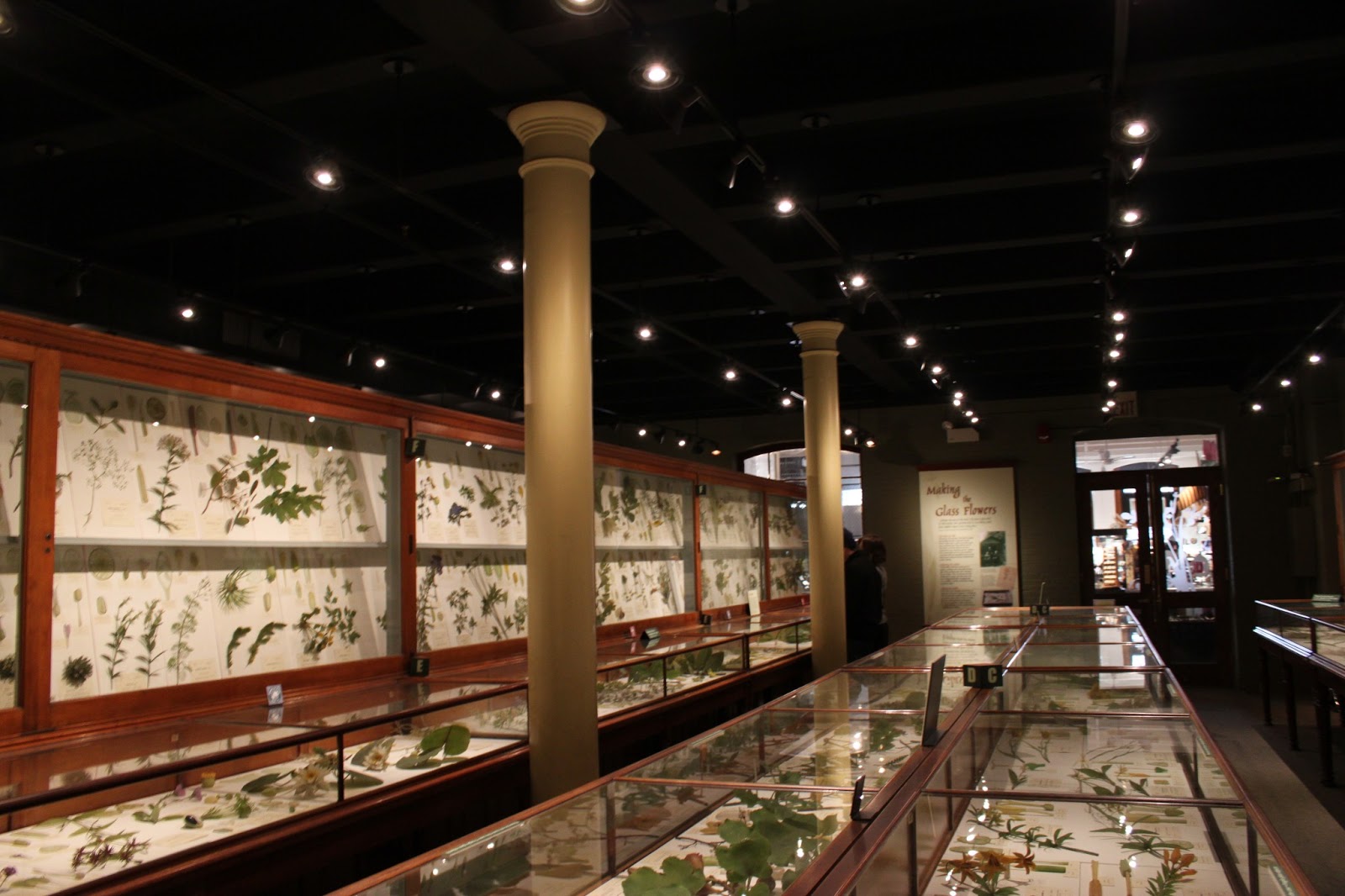
But it was the glass flowers that piqued my interest. In the late 1800s, a father and son from Germany created a collection of more than 4,000 glass flowers based on 800 different plant species. Leopold and Rudolph Blaschka started by making glass models of invertebrate animals, which captivated the attention of a Mr. George Lincoln Goodale, who happened to be in the process of founding Harvard's Botanical Museum. Dissatisfied with the lifeless wax models used at the time, he called upon the Blaschkas for help who in turn created the incredible collection I saw today. And it truly IS incredible. The level of detail and accuracy is uncanny and a joy to see. These men were true artists and skilled craftsman. The glass models look as real as any wildflower picked in a meadow or any daffodil grown in your garden. It was hard to leave them.
A Lady in Boston All rights reserved © Blog Milk Powered by Blogger